What it means to map the human phenome
Your genome is the code you were born with. Your phenome is the story of your whole life. Here is why putting it together could help cure cancer.

Listen to this article 8 min
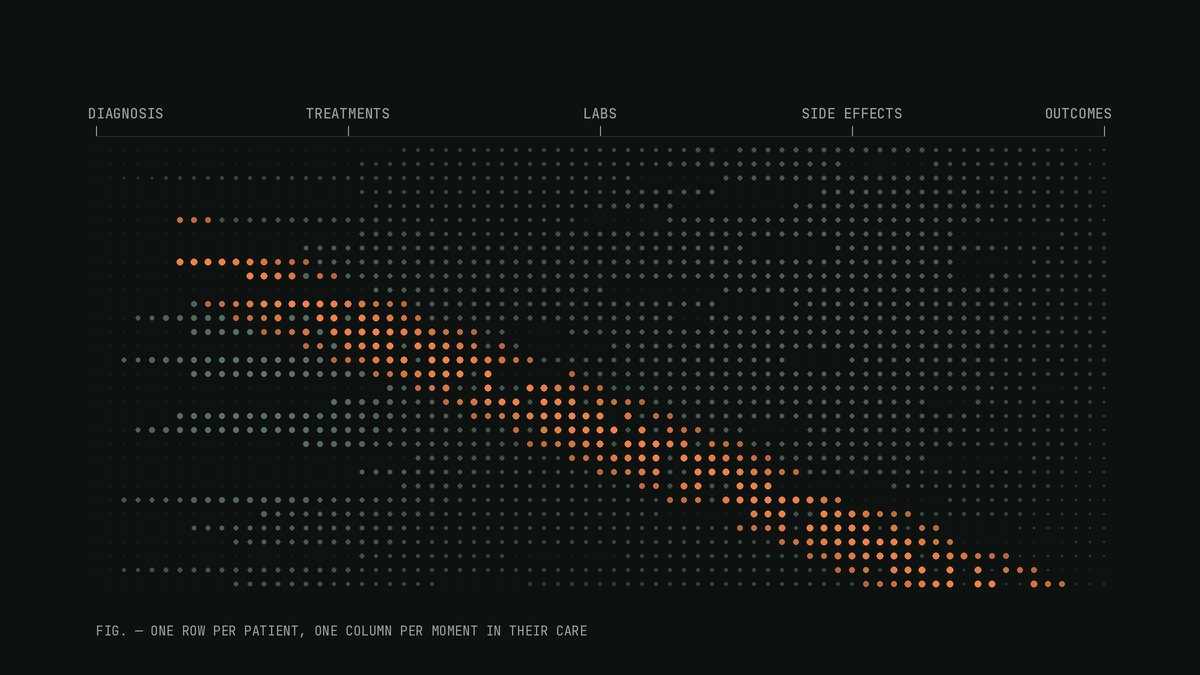
On my homepage I say that at HealthTree we're pretty h*cking close to mapping the human phenome. That's a big claim. So here is what it means, and why I think it matters.
This is my own take as one of the engineers at HealthTree. It is not an official HealthTree statement, and it is not medical advice.
It started with a question about bombs
In December 1984, a small group of scientists met at a ski lodge in Alta, Utah. They had one hard question. Did the atomic bombs dropped on Hiroshima and Nagasaki change the genes that survivors passed on to their kids?
They could not answer it. The tools did not exist yet. One of them said they would have to read the whole human genome to know.
That meeting helped start the Human Genome Project. A year later, a leader at the Department of Energy read the report from that meeting and first had the idea for the project. It went on to read all of our DNA, from start to finish. It was done in 2003.
The missing piece
Your genome is your DNA. It is the code you were born with and it is a marvel that we were able to map out all of it. But your genes only tell part of the story.
The rest is what really happens to you. What you got sick with, and when. Every blood test and every scan you have taken. How you healed from a broken leg as a kid. Where you lived and what chemicals and pesticides you were exposed to. How fit you are. Which drugs worked for you, and which ones did not. Your diet, how many steps you walk, and you can get as granular as your daily habits. What matters is how your body acts, reacts and moves through the exposure of the world around you.
All of that together is your phenome. Scientists started calling it the missing piece in the 1990s. In 2003, two of them called for a Human Phenome Project to map it, the same way we mapped the genome. The call from these researches states,
"Our current approaches for defining and assaying phenotypes may be inadequate for making optimal use of such genotypic data. We propose an international effort to create phenomic databases, that is, comprehensive assemblages of systematically collected phenotypic information, and to develop new approaches for analyzing such phenotypic data."
Collecting a human phenome is not only for sick people. Healthy people have a phenome too. And the best medicine is the kind that keeps you from getting sick in the first place.
Your story is stuck in pieces
Here is the problem. Your health story is spread out. Some of it is at the hospital. Some is at the cancer center, the lab, the drug store and your old family doctor. Some of it is on your watch.
Most of these places can't talk to each other. Their systems don't match, and privacy rules keep each record locked where it was made. So no one sees the whole picture. Not your doctors. Not researchers. Often not even you.
Putting the pieces together is hard
A Personal Health Record fixes this. It puts your whole story in one place that you own. At HealthTree, patients connect the records from every place they have been treated. Then we check those records, clean them up and put them in order.
This is incredibly difficult. Every hospital and clinic keeps records its own way. To pull them together, you have to work with each place, create technology, rules and formats for how that data can get exposed and transfered. Building out these connections between these facilities one at a time takes years of slow, careful work. The code and abstractions for such work can be easy at times. The people are the hardest part.
This type of works requires high trust. High trust from research facilities, from pharmecutical companies but most importantly from patients and caregivers. So the only way that this can ever be accomplished is by maximizing the trust between us and our client, the patient. Our only true client is the patient. Of course we have to do some stuff to secure funding from pharma as we are a non profit and if we didn't we wouldn't exist. However, everything we do is to wrap ourselves around solving the problems of the patient. That is why we have HealthTree working in tandem with HealthKey. HealthTree branches out (pun intended) to helps support patients with all the resources they need to deal with cancer. Social, financial, educational, coaching, and more. HealthKey offers the technological patient and clinical data management side.
Everything we offer must be free and open to the patient to obtain. No pay walls. No exclusionary actions or tactics. If you need support we can help you. If you need medical mapping and record formatting. We got you. All free.
Our patient facing teams are filled with some of the kindest people in the universe. Feel free to reach out to them if you need help.
We must love, support, and care for those who are going through life's toughest challenges with the utmost respect and delicacy.
Only after the trust of patients is obtained can what we do next work. Then we allow you to connect your medical records. You trust us, you know what we are doing is in support of you and only you. Why does this work? It works because the patient is in charge. Not us. You have a legal right to your own records. You choose to bring them together. You choose who gets to see them and if they are deleted or not. We retain no data if you remove it. If you don't want to be here? no one is making you stay.
Teaching the records to speak one language
Even after you gather the records, they don't match. One hospital uses one code for a disease. A lab uses a different code for the same blood test. A doctor's note just says it in plain words.
To fix this, we use PRomop. It was built by Adam Blum and his team at HealthKey, a partner of HealthTree. PRomop takes records in FHIR, a common format for health data. It maps them into OMOP, a shared standard that researchers around the world already use. Then it builds one clear record for each patient.
PRomop is open source. Anyone can read the code, and people can help build it. If you want the details, you can read the paper.
This is the big step. Now we can take records from almost anywhere, with almost any medical code, and line them up in one view. Lab work. Scans like CT and MRI. Heart rate from a watch. Notes from your doctor.
What you can do with your record
Once your story is in one place, it starts to work for you.
Find clinical trials. If a treatment stops working, we can match you to trials on ClinicalTrials.gov that fit your record. Then you can talk them over with your doctor.
See what has worked for people like you. Your record can show which treatments have gone best for patients with a story like yours. You and your care team still decide. You just walk in knowing more.
Meet your twins. Our twin matching finds people whose genes, health and history look a lot like yours. Then it shows how they did on different drugs.
Kill the clipboard. You should never have to fill out the same forms again. Pull up your record, let the clinic scan it, and they get the whole thing. It can also save you from tests you don't need.
This is not just an idea. It has already helped patients find the right expert and the right treatment. Some of them are in remission today. Some might not be alive without it.
Your data can help someone else
Not every cancer patient will live to see a cure. That is the hard truth. But their story does not have to sit in a file. It can help the next person.
When a patient says yes, their record can be shared with researchers. First we take off their name and anything else that could point back to them. HealthTree does not sell the data, and we don't own it. It belongs to the patient. We just keep it safe, in a form that researchers can really study.
So why are we close?
Two things changed. First, enough patients have joined that we are reaching critical mass. Second, PRomop now lets us map records from almost anywhere into one shared standard.
Put those together and you get something no single hospital has. It is a real map of what happens to people over years of their lives. Not one person's phenome, but a whole community's. That is what I mean when I say we're close.
If this is you
If you or someone you love has cancer, take a look at healthtree.org. The Personal Health Record is free for cancer patients, and you stay in control of what you share.
Keep reading
-
Stop trying to make one AI model do everything
You do not need a genius model. You need 80 small ones that stay consistent. Prompt edits are not a training loop.
Comments
No comments yet. Be the first to share your thoughts.